
Jonah Naplan June 18, 2026
It’s been such a joy growing up with Buzz and Woody. The “Toy Story” movies were some of the very first that I can remember watching, sitting on my mom’s lap at my grandparents’ house as the world-wearied cowboy and hotshot space ranger barrelled headfirst towards the moving truck in the 1995 original. I vividly recall attending to the screen with equal intensity at the wonderful and sometimes terrifying exploits of this oddball group of playthings in the second and third adventures (the incinerator scene from the latter remains just as haunting as the first time I saw it), and spent hours rewatching the “Toons” and holiday specials, which centered on all the “lesser-knowns,” from Rex, to Barbie and Ken, to Trixie the Triceratops. I dressed up as Buzz Lightyear for Halloween at five years old, and took to collecting all of the toys and character stuffed animals. “Toy Story 4” was the first I got to see in the theater in 2019, my excitement largely trumping the widespread complaint that they really should have ended after the perfect ending of “3.” But it was a hit nevertheless and became the highest grossing in the franchise. Which brings us to “5.”
I think it goes largely underappreciated how lucky we’ve been that the “Toy Story” movies after “3”—including “Lightyear” from 2022—have not just been merely cash grabs, but films that succeed entirely on their own terms, telling valuable stories that justify the existence of the whole project. The latest one, “Toy Story 5,” directed by Pixar legend Andrew Stanton, and written by him and Kenna Harris, does an even better job at this than “4,” as it functions more like a cautionary tale than anything else. These toys, most of them, anyway, have lived through at least two owners, escaped the dreadful boy next door, an eccentric collector, an ominous teddy bear, likely survived a pandemic, been thrown around, beat up, and faced existential crises aplenty. But their true nemesis hasn’t fully revealed itself until this movie: tech.
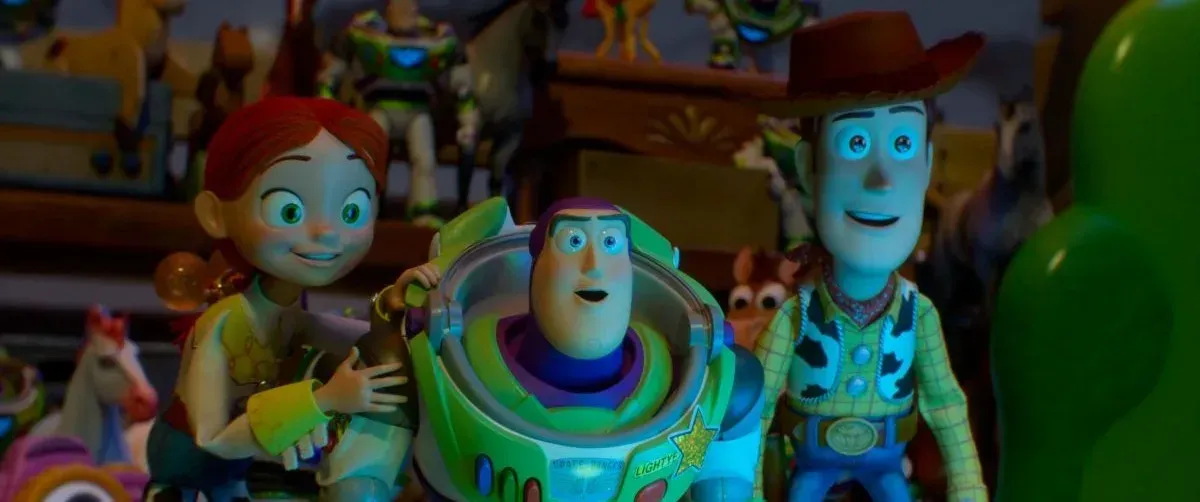
I suppose it was inevitable that a franchise fundamentally about the ways that children use their imaginations to express themselves and whatever tools surround them to create entire worlds inside their head would touch on the startling emergence of technology in the lives of the youth. But the way it’s done here is probably more stylish, timely, and emotionally relevant than you’d expect. The whole gang has returned, including Buzz (Tim Allen), Jessie (Joan Cusack), Rex (Wallace Shawn), and, of course, Woody (Tom Hanks), who gets ushered back into the picture when the toys’ precocious eight-year-old owner Bonnie (Scarlett Spears) receives a frog-shaped tablet called a Lilypad, and becomes obsessed, glued to the device’s interactive games and instant endorphins, and neglecting all the toys she swore to dote on only a day earlier as a result.
There’s a lot of obvious routes Pixar could have gone down using this set-up, but the ones they actually chose to pursue will end up surprising you in ways you’d never expect. After Lilypad (voiced by Greta Lee, who was so excellent in “Past Lives” and “Tron: Ares”) manages to make new friends for Bonnie in approximately 15 seconds, she’s sleepover bound with a group of three girls her age, all similarly engrossed in their screens. After Jessie and her loyal horse Bullseye stow themselves away in Bonnie’s suitcase, her new “friends” immediately mock her for bringing toys to the sleepover, and she retreats, grabbing for her Lilypad to “fit in” instead of the dolls that once brought her so much joy. Mix-ups and mayhem abound, and as a result of their abandonment, Jessie and Bullseye somehow find themselves back at the former home of Jessie’s first owner Emily, discovering that a new family lives there now with a young girl named Blaze (Mykal-Michelle Harris), who shares Emily’s love of riding horses and the cowgirl aesthetic.
I don’t want to get into much more about the plot, because it’s all brilliantly layered, and “Toy Story 5” is one of those special animated movies, alongside the other “Toy Stories” as well as personal Pixar favorites of mine like “Inside Out” and “Coco,” that becomes more and more rewarding as the plot unfolds and each new development becomes a pleasant surprise when you don’t know where it’s taking you. The harshest critics will say it’s crudely overstuffed at under two hours, with numerous B-plots including one following a marooned shipment of 50 “high tech” Buzz Lightyear models that would probably work better as a self-contained short film but is perfectly welcome and charming within the plot weeds of the movie, and a budding romance between Jessie and Buzz, as the latter works up the courage to propose to the former. The most notable of the bunch introduces a trio of toy/tech hybrids once loved by Blaze, including a toilet training device called Smarty Pants (the scene-stealing hijinks of Conan O’Brien), a digital camera named Snappy (Shelby Rabara), and a navigational tool named Atlas (Craig Robinson), all of whom play an instrumental role in helping Jessie and Bullseye get back to Bonnie and, ultimately, arranging for Bonnie and Blaze to meet and become friends.
There’s something so refreshing about a new movie that doesn’t have a traditional “villain,” but instead a misunderstood adversary of sorts who blindly believes they’re doing the right thing because of their narrow worldview. Lilypad symbolizes something broad rather than specific; she’s representative of all the features of cellphones, computers, and educational devices combined because what she actually is doesn’t matter as much as what she promotes. “Toy Story 5” includes a lot of unexpectedly haunting imagery, most of which depicts how too much technology (particularly an overreliance on it at an early age) can alter our brain chemistry, sometimes shutting us off and alienating us from the world. A single shot can be both breathtaking and terrifying at the same time, as it portrays an unsettling truth, such as when Jessie peers from the rooftop, aghast to find that all of the neighborhood kids are enveloped in the blue-white light of their screens except for Bonnie. The animation is stunningly realistic, visually and intellectually.
If the other “Toy Story” movies focused on how our emotional connection to toys and other figments of our childhoods change as we grow up, then this one harkens more back to the thesis of “Toy Story 2,” which used the storyline of Jessie and Emily to illustrate how something new and exciting can always replace the toys that once inspired our imaginations. That parallel is what really makes “Toy Story 5” Jessie’s movie to lead, both in a physical sense (a good portion of the runtime takes place AT Emily’s house) and in a spiritual one; Jessie takes the lessons she learned decades ago, and applies them to this modern scenario, which has a different, artificial skin, but is all the same underneath. Indeed, Woody doesn’t end up terribly relevant to the plot of “Toy Story 5,” but his age-old philosophy that there’s “nothing new under the sun” does.
The result is a beautiful animated film that will likely speak even more to the parents who see it than to the children. And, strangely enough, the movie ends up an even more effective annotation on the nature of empathy than Steven Spielberg’s tryhard “Disclosure Day” last weekend. Through my experience performing on stage, I’ve learned a lot about how working actors tend to understand empathy better than anybody else because the basis of their art form depends on them listening—truly listening—to their counterpart. The ability (or inability) to live in the moment, engaging with your friends and loved ones face-to-face, allowing your imagination to flower through authentic human interaction and hands-on creativity, is an idea that “Toy Story 5” explores wonderfully, and that lies within the subtext of this otherwise fantastically entertaining, briskly-edited, gorgeous-looking movie, for those who care to look for it.
Pixar’s real triumph with the “Toy Story” franchise has always been their knack for illustrating the beauty in the mundane: the toys we loved, the home we grew up in, the neighborhood adventures we went on. For years, Woody and Buzz acted as meaningful emblems of the interplay between the dated past and the exciting future, the human growth of their owner telegraphed only through them. “Toy Story 5” could have taken the exact same path, but it doesn’t—instead, for the first time in franchise history, it gives the principal child a tangible arc, showing not just how Bonnie impacts the toys but how they impact her. We know the message at the end can’t be entirely anti-tech, so it concludes with something we already knew going in. Its willingness to resolve on a note that highlights reality as it is without sugarcoating the truth is a triumph all of the movie’s own.
Complaints that the franchise should have ended after “Toy Story 3” are valid on the grounds that the trilogy ended in a perfect way. But while that may be true, I don’t think there’s anything wrong with reviving this world again and again as long as the movies are good and the stories are worth telling. If “3” was the last one, I’d never have gotten to see a “Toy Story” movie in the theater, nor would I be able to stick with these characters as I near adulthood myself. As somebody who shares the same anxieties as Jessie about growing up too fast, I’m grateful to have this piece of my childhood to always be able to grab onto. Adulthood may be coming too soon, but this movie’s right on time.
Now playing in theaters.