
Jonah Naplan June 11, 2026
Steven Spielberg believes. He believes in life outside our reach; that aliens lead comfortable lives on planets of their own. He believes in science and mathematics; that they are the fabric of the known universe and make up our most universal language. He believes in the compassion and goodness of human beings; that it’s in our nature to love and care for one another. And he believes in humanity’s ability to believe. Over the course of five decades, he’s pointed towards this belief system in movies such as “Close Encounters of the Third Kind,” “E.T. the Extra-Terrestrial,” and even “Indiana Jones and the Kingdom of the Crystal Skull,” and as he (likely) nears the end of his legendary career, he’s returned to those same roots that put him on the map with “Disclosure Day.” But the magic he once captured in his earlier explorations of extraterrestrial life feel largely lost amidst the muddled machinations of the plot of his latest film, which surely has something important to say but, despite a star cast and expert moviemaking, never manages to disclose it effectively.
After arguably two of the best and most grounded films of his career, “West Side Story” and “The Fabelmans,” Spielberg’s newest has much more in common with something like “Ready Player One” than any of his more personal, near-autobiographical endeavors. Taking place right here, right now, “Disclosure Day” largely follows two separate stories that will soon converge into one. The first is that of Daniel Kellner (the predictably excellent Josh O’Connor) who’s on the run from the corporation Wardex, headed by the evil Noah Scanlon (Colin Firth). For years, Wardex has been covering up the government’s exploitation and abuse of extraterrestrial life, and Kellner is the only person with evidence of it, possessing dozens of disturbing video files that he’s been waiting for the right moment to leak to the public. The other is of Margaret Fairchild (Emily Blunt), a Kansas City meterologist whose morning broadcast is interrupted one day when she starts involuntarily speaking in an alien language on-air.
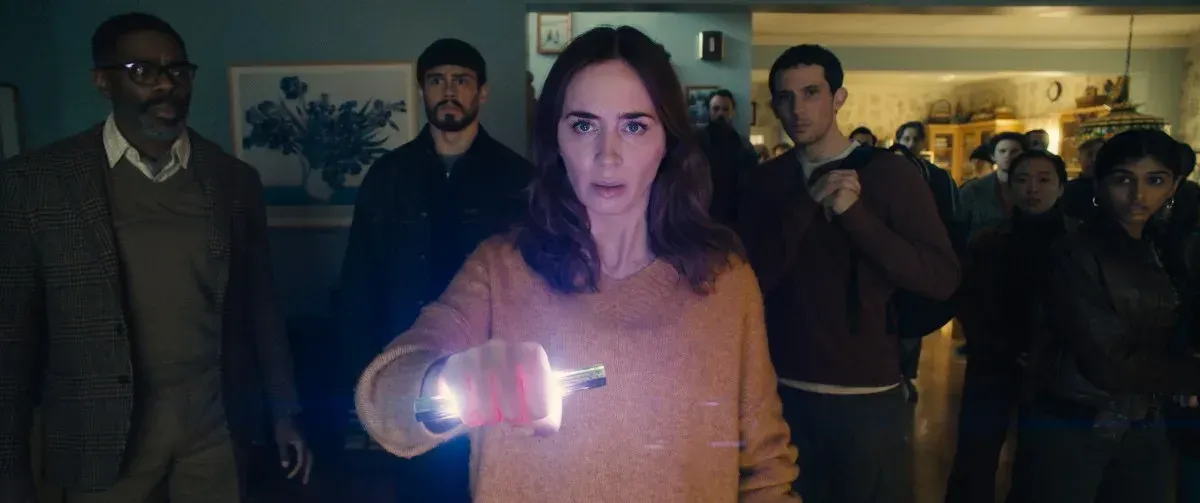
The collision of these two anecdotes is no coincidence; Daniel and co-operative Hugo Wakefield (Colman Domingo) see Fairchild’s incident as clear of a sign as any that it’s time for disclosure, and most of the movie’s unnecessarily lengthy 145 minutes turn into one big chase scene as Scanlon and his goons take off after Daniel and his girlfriend Jane (Eve Hewson) as they race to locate Margaret. There’s more overcomplicated technicalities, too, involving a crucial “device” that looks like a smoothly-sanded rock, and David Koepp’s (“Jurassic Park,” “War of the Worlds”) disjointed script never fully explains what specifically this object does nor why Scanlon cherishes it so much. Don’t even mention the movie’s eye-color-changing marketing gimmick, or the cabal of bafflingly-rendered CGI animals that squeeze into the plot somehow, someway.
I’ve seen “Disclosure Day” twice now, and both times I kept thinking to myself, “Really, Spielberg? Really?” The movie is an, at times, appalling mixture of everything he’s great at—those little trademarks he’s built his career on—as well as problems that I never thought the director of some of my favorite movies ever would have. The biggest mystery of all is how the man who arguably invented the summer blockbuster, dating all the way back to “Jaws” in 1975, has made a movie that strays so far away from being fun and exciting, even despite all the machinations of the plotting. Spielberg directs the hell out of a couple standout sequences, including a nail-biter setpiece on a train track, as well as the final 20 minutes which (maybe?) get to the heart of what he’s trying to say, but taken as a whole, “Disclosure Day” sorely lacks the consistent momentum of his best science-fiction work in “Minority Report” and “A.I. Artificial Intelligence.” Entire sequences here are questionably bland and uninspired and feel spat out by ChatGPT after it was fed the rest of Spielberg’s filmography.
Throughout, there’s a sense that the auteur is simply playing to his greatest hits in a way that’s dumbed-down and less thematically effective than usual. Koepp’s regularly scattered script does a poor job from the very beginning of establishing the central characters and their relationships, which makes it difficult to cling onto them emotionally as they’re thrust into the action. It doesn’t help that the movie sort of tosses the viewer right into the thick of the plot from the start, missing a lot of the essential exposition and set-up that could get us invested in this world. Instead, Daniel’s first scene plays like a generic confrontation we might see in a second-rate action/thriller, and Margaret’s reads incredibly awkward, as she complains to her boyfriend Jackson (Wyatt Russell) about not belonging.
The latter theme is something that Spielberg certainly could have explored at a deeper level if the movie wasn’t concerned with so many other things. “Disclosure Day” somehow gets less and less enjoyable as the plot develops, losing the personal touch of Spielberg’s best work and becoming overly mechanical in a way nobody came to see. The fact that all of the performances are very good starts to matter less when it’s a struggle to care about their adventures. Blunt, in particular, is failed by a movie that never really allows her to become anything more than a cog in the endless machinery, ushered around from place to place because of the volatility of her “special abilities,” but “Disclosure Day” isn’t precise about the extent of them. Firth’s villain is really only defined by the fact that he’s just capital-B “bad,” and doesn’t get developed further than that, and the revelation that Hewson’s character was once a novitiate hints that the movie will explore faith and spirituality as it plays into beliefs about life outside our universe, and then it…doesn’t.
A mid-movie monologue from Domingo to Firth, two masters of this medium, about empathy, is the one time where Spielberg and Koepp get on the same page about what “Disclosure Day” is truly getting at. The idea that entire alien cultures operate on mutual understanding, both logically and emotionally, is a smart idea, and an effective way to shine a light on how divided humankind, by contrast, can get over the silliest conflicts. This will always be true. But a lot of other things change over time, which is why the final act, while at times impactful, feels like Spielberg is out of touch with reality, relying on conveniences from another era to justify the climax of a movie that is otherwise so rooted in its contemporary background. That maybe the film’s best performance of all only arrives in the last 20 minutes drives home the point that “Disclosure Day” just came too late.
And yet, as a massive Spielberg junkie, it’s still difficult for me to fully dismiss the pleasures that are just inherent to an outing from this director. It’s so well-shot by typical collaborator Janusz Kamiński, who continues to demonstrate such an acute understanding of space and how camerawork is what makes an action sequence propulsive, while the horns of the score by John Williams are immediately evocative of retro classics that may be better but share the same musical undertones. There’s also always the sense that Spielberg is making movies because he just loves the art form so dearly and wants to give audiences a special experience. The same intention is felt here even if the result is hazy.
Despite its challenges, “Disclosure Day” technically could have been worse, but it definitely should have been better. I suppose it’s a credit to the director’s incredible filmography, though, that the movie’s lack of original or interesting ideas can be forgiven because Spielberg has already used them all up himself.
Now playing in theaters.