
Jonah Naplan December 18, 2025
For his entire career, director James Cameron has been the master of spectacle, producing three of the top five highest grossing movies of all time, between the first “Avatar,” which was technologically revolutionary for its era in 2009, its long-overdue 2022 sequel “The Way of Water,” and the soapy but nonetheless brilliant “Titanic,” which was such a massive phenomenon that it launched both Leonardo DiCaprio and Kate Winslet to worldwide stardom. Since arguably the early 80s, Cameron has been one of the kings of the industry, a pop culture magnate who single-handedly salvages movie theaters from going extinct every time he has a new project out. Which brings us to “Avatar: Fire and Ash,” a massive blockbuster of monumental proportions. It will probably see similar success, just because word of mouth will carry that it’s worth going out to see on the big screen rather than waiting a couple months to watch at home. Indeed, Cameron’s wonderfully realized world remains mesmerizing, and washes right over you instantly as though you’d never left. But the technical prowess this time around can’t quite disguise the fact that “Fire and Ash” is mostly a retread of old paths rather than a set of new ones, which gets exhausting as the 192-minute runtime unfolds. We’ve been on this same journey before.
A fundamental principle of the “Avatar” movies has always been that they’re films to be experienced, not nitpicked. Cameron has designed them as visual spectacles that invent an exotic new flora-and-fauna-filled world in real time, with cheeky intimations of “family” hiding unsubtly in the margins, not meant to be considered as overarching themes, but as thought prompts. There isn’t much “storytelling” or “plotting” in the traditional sense of the words, instead just prolonged sequences of exuberant motion capture and visual work that are exciting because somebody’s riding a sea creature or playing tag in the treetops, not because they actually mean anything. We eat it up because it’s all well-designed and incredibly immersive.
The same mostly applies here. Taking place shortly after its predecessor, “Fire and Ash” picks up again in Pandora with Jake Sully (Sam Worthington) and Neytiri (Zoe Saldaña) and their Na’vi family, who are all distraught and grieving over the death of the eldest child Neteyam in the climax of “The Way of Water.” The other son Lo’ak (Britain Dalton) blames himself for the casualty, and has a rocky relationship with his father because of it, who’s recently taken to arming their tribe, and the neighboring Metkayina clan, headed by Tonowari (Cliff Curtis) and Ronal (Kate Winslet), with military-grade carbines to protect themselves from future danger.
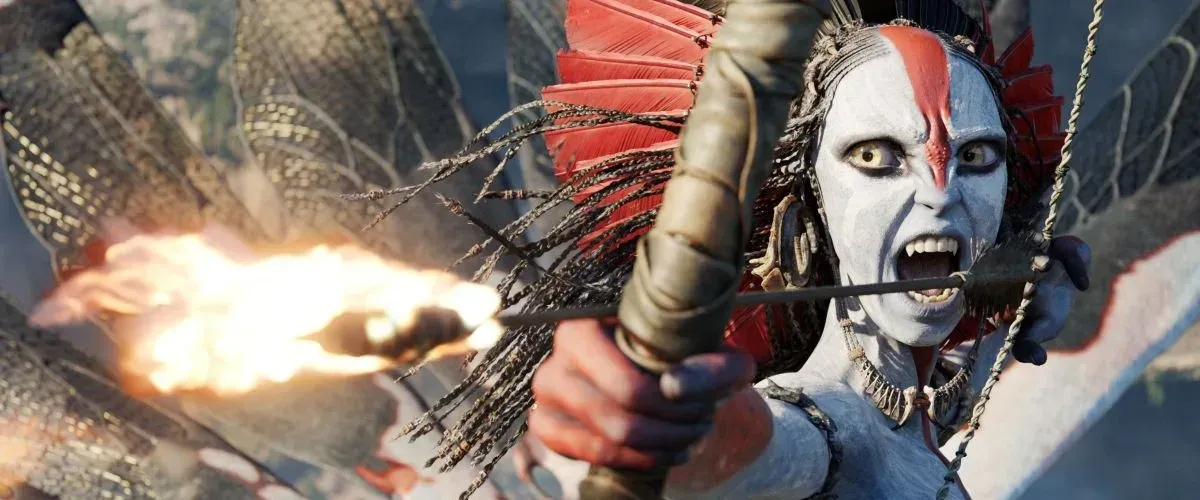
It eventually arrives in the form of Varang (Oona Chaplin) the leader of an ashy-skinned, cultlike group of warriors known as the Mangkwan, and the return of the Sky People, commandeered by a returning Miles Quaritch (Stephen Lang). The ensuing violence and destruction splits up Jake and Neytiri from Lo’ak and their other children, including Kiri (Sigourney Weaver), and little Tuk (Trinity Jo-Li Bliss), as well as the teenage human they’ve taken under their wing named Spider (Jack Champion). When a bit of Kiri’s magic allows Spider to breathe in the Na’vi world without his mask, Quaritch realizes that this young man might be the key to the Sky People’s domination of Pandora.
Written by Cameron, Amanda Silver, and Rick Jaffa, “Fire and Ash” has a number of standout sequences throughout, but is so remarkably similar to “The Way of Water,” all the way down to its land-and-sea, ships-and-explosions finale, that the two movies will be nearly indistinguishable from each other in ten years. And at comfortably over three hours, there’s not enough new to justify the need for the runtime. Again, you couldn’t say there’s much of a plot, but some of the shared beats include a conflict over threatened sea creatures known as “tulkun,” tribal rivalries, the exploration of a new world, Spider reckoning with his identity as an outsider (even more so in this one), and, of course, Quaritch trying to ruin the wellbeing of the Na’vi people and their planet (like the “Harry Potter” and “Terminator” movies, the “Avatar” series has joined the ranks of other franchises that keep the same villain over and over again). It’s all good stuff, but it was all better in the last movie, and while watching “Fire and Ash” you feel like it’s time for a shake-up.
One way the film stands out, though, is in the inclusion of Varang, who ultimately becomes a sort-of secondary adversary to Quaritch through their shared goals. In a seduction scene that curiously mirrors one from the opening of “One Battle After Another,” these two baddies create a hypnotic bond that makes for one of the most dynamic scenes in the entire franchise. It feels good to know that in the midst of learning how to utilize all of the industry’s newest moviemaking technology, Cameron also took to heart the novel ways in which two characters can interact with one another. “Fire and Ash” is saddled with several great intimate moments like this, as the Na’vi engage with each other or with nature.
Of course, the action’s awesome too, but that’s to be expected by this point. The IMAX 3D, high-frame-rate screening I attended made the visuals overwhelming in a net positive way, demonstrating Cameron’s masterful talent at not just aweing with the action, but sweeping the audience into it, flying us up into the air with the aerial apex predators, or down into the ocean where a similarly rich ecosystem finds its home. It’s so overstimulating that you lose track of where all the main characters (of which there are so many at this point) are at any given time during the action. Not everyone gets their moment to shine, with both Neytiri and Lo’ak feeling like also-rans amidst the chaos, but by the end of it all, you’ll feel the triumph and relief of the Sully family who learn to forgive each other and process their grief in a way that won’t hurt themselves any further.
Great sequels build upon their predecessors, expanding the world of the previous movies without repeating what came before. While “Avatar: Fire and Ash” doesn’t exactly do this, James Cameron has crafted another majestic, full-sensory experience that truly feels hard to hate. Movies rarely feel “big” these days, but this one is undeniably giant, bursting with life in every frame, and creating an incredible world that calls you to return to it. The magic’s still there, even if it feels a tad too familiar.
Now playing in theaters.